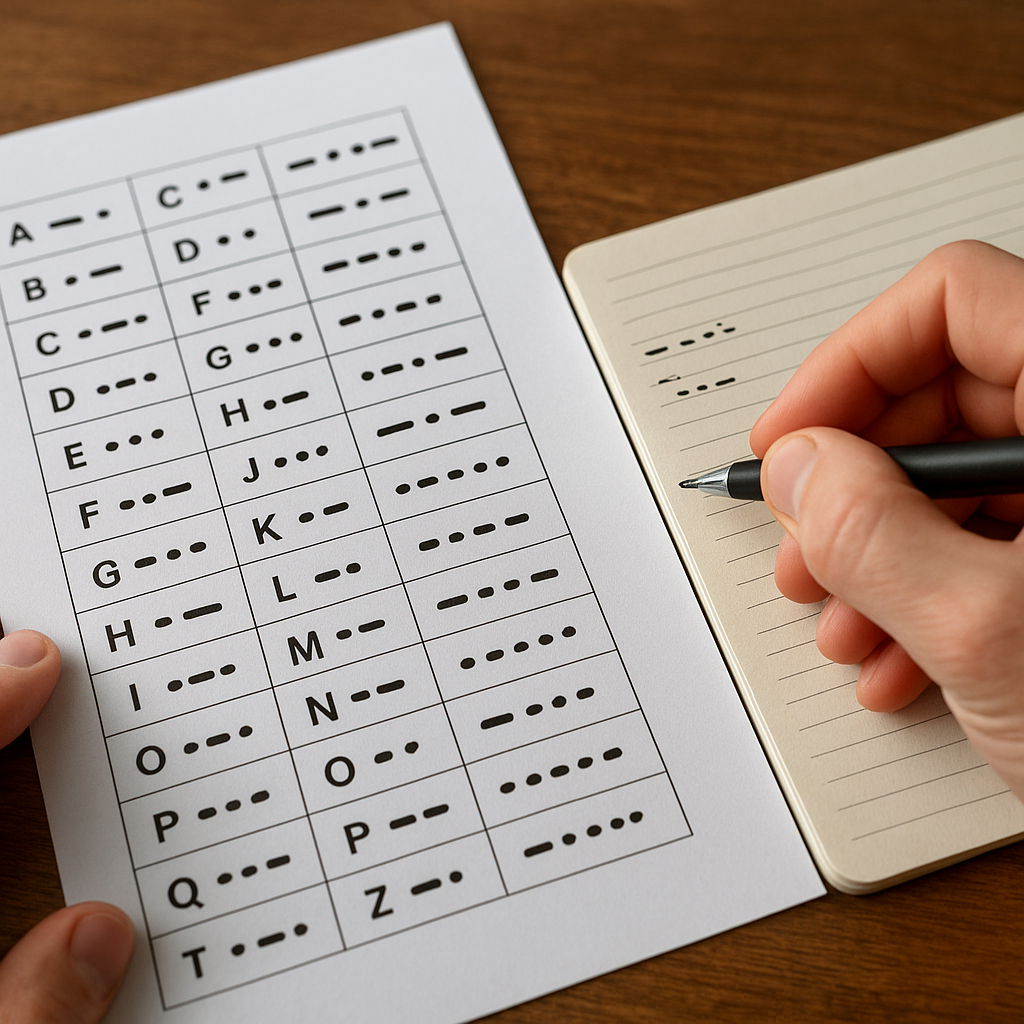
Start by learning characters as sounds, introduce only a few at a time, and use extra spacing when recognition needs breathing room. Practice in short, regular sessions rather than occasional marathons. That is the practical answer to how to learn Morse code quickly: make practice efficient, not rushed. There is no guaranteed mastery deadline. The first task is simple: open an audio trainer, choose a small character set, listen, and record what you hear.
The Fastest Practical Starting Point: Learn the Sounds
For receiving audible Morse, aim for auditory recognition: hearing a character’s rhythm and recognizing its letter directly. Avoid making a mental picture of dots and dashes, then translating that picture into a letter. That extra step can become a bottleneck as messages get faster.
A dot is commonly spoken as a “dit,” and a dash as a “dah.” Together, dits and dahs give each character a distinctive rhythm. Listen to each pattern as a complete sound:
- E is one dot: dit.
- T is one dash: dah.
- A is dot-dash: dit-dah.
- N is dash-dot: dah-dit.
For example, when the trainer plays dit-dah, the response should become “A,” rather than “one dot, one dash, therefore A.” Start with isolated characters, then hear them in mixed sequences so their order cannot supply the answer.
The ITU recommendation on International Morse code specifies the standard character patterns and timing conventions. A Morse code alphabet chart is useful for checking an unfamiliar character, but it should not replace listening practice.
Interested in flashing-light Morse instead? The character patterns remain the same, but recognition also needs practice with actual light signals. Audio practice alone does not train that visual skill.
Use the Koch Method and Farnsworth Timing Together
These approaches solve different problems. The Koch method controls how many characters enter practice. Farnsworth timing controls how much space separates them. They can work together.
Koch Method: Add Characters Gradually
Koch practice starts with a small character set instead of presenting the whole alphabet at once. The basic cycle is straightforward:
- Begin with a small set, such as two characters.
- Listen to mixed sequences containing only those characters.
- Write or type what you hear.
- Compare the copy with the answer and check accuracy.
- Add another character when recognition is consistently reliable.
There is no need to treat one character order or accuracy threshold as universal. Follow a trainer’s progression rule if it suits the session, but recognize it as that trainer’s setting. One unusually good attempt is less useful than reliable results across several attempts.
LCWO’s online Morse code trainer provides browser-based Morse practice, including Koch-method training.
Farnsworth Timing: Keep the Rhythm, Add Thinking Time
Character speed describes how quickly the elements within each character are sent. Effective speed describes the overall message rate, including the spacing between characters and words. Trainers may display both in words per minute, or WPM, a standardized measure of Morse speed.
With Farnsworth timing, characters retain a brisk internal rhythm while longer character spacing and word spacing lower the effective speed. This gives a beginner more time to recognize and record each character.
For example, a trainer might send characters at 20 WPM but space them for an effective speed of 10 WPM. Those figures illustrate the distinction; they are not required starting settings.
Farnsworth timing adds room between characters and words. It does not stretch every individual dit and dah.
Choose Your Starting Settings
Choose a character speed at which the pattern sounds like a recognizable rhythm, then add enough spacing to make copying manageable. No single WPM setting is the fastest choice for every beginner.
- If most characters feel unfamiliar, reduce the character set.
- If recognition works but writing falls behind, increase spacing.
- If attention fades, shorten the session.
- If copying becomes consistently comfortable, add a character or reduce spacing slightly.
Change one variable at a time. Adding several characters while reducing spacing makes mistakes harder to diagnose.
A Simple Daily Morse Code Practice Routine
The following 11–16-minute routine is a suggested starting point, not a scientifically established optimum. Shorten it when concentration drops, or split it into two sessions for spaced practice across the day.
| Stage | Suggested time | What to do | What to record |
|---|---|---|---|
| Review | 2–3 minutes | Listen to familiar characters. | Characters that still cause hesitation. |
| Focused practice | 5–7 minutes | Practice the current character set in mixed sequences. | Copying accuracy. |
| Targeted correction | 2–3 minutes | Revisit confused characters, then mix them back into the set. | Recurring substitutions. |
| Short message practice | 2–3 minutes | Try words or short messages appropriate to the current level. | Recognition difficulties. |
Only know a few characters? Replace the message stage with suitable practice sequences. Complete sentences can wait. Random character groups help test recognition without letting a familiar phrase supply missing letters.
During copying practice, leave a blank for a missed character and keep listening. Trying to reconstruct it while the next characters arrive can turn one miss into several. Review the gap afterward.
Track Progress Without Chasing Speed
A simple log makes accuracy tracking useful without turning practice into paperwork. Record:
- Date.
- Character set.
- Character speed and effective speed, if both are displayed.
- Accuracy, using the same scoring approach between sessions.
- Frequently confused characters.
Progress can mean fewer substitutions, less hesitation, a larger character set, or comfortable copying with shorter gaps. A higher WPM figure is only one measure. Avoid comparing scores from very different settings as though the tasks were identical.
A Seven-Day Starter Plan
This is a first-week framework, not a promise of mastering Morse code in seven days. Repeat a stage whenever recognition remains inconsistent.
- Day 1: Choose an audio trainer, begin with a small character set, and find manageable spacing. Record a baseline without worrying about speed.
- Days 2–3: Reinforce the same sounds in mixed sequences. Add another character only when the current set is reliably recognizable.
- Days 4–5: Continue gradual expansion. Give recurring substitutions a short correction session, then return those characters to mixed practice.
- Days 6–7: Consolidate the current set. Try suitable short words or messages if the available characters allow them; otherwise, continue with varied groups.
Finishing the alphabet is not a first-week requirement. Numbers and punctuation can enter gradually too. The useful outcome is a repeatable routine and a clear sense of what needs attention next.
Common Mistakes That Make Learning Slower
- Relying entirely on visual memorization. Use a chart for reference, then return to Morse code practice audio. The target is a direct sound-to-character connection.
- Counting individual signals. Listen again for the whole character rhythm. Reduce the character set or add spacing if counting has become the only way to cope.
- Adding too many characters at once. Return to a manageable set, stabilize it, and expand gradually.
- Increasing speed before accuracy settles. Keep the current settings until copying is more consistent, then make one small adjustment.
- Practicing only predictable sequences. Mix the order and include random character groups. Familiar sequences can hide recognition gaps.
- Doing long, tiring sessions. Stop when attention slips. A shorter focused session is more useful than continuing while guessing.
- Expecting receiving and sending to develop identically. Sending Morse code is a separate timing skill. Practice clean element lengths and spacing rather than assuming recognition automatically produces accurate sending.
Recognizing the SOS distress signal is not the same as copying unfamiliar messages. Familiar patterns are useful, but general reception needs a broader range of listening practice.
Tools and References to Get Started
Keep the resource set small: one browser-based audio trainer, one authoritative code reference, and established learning guidance. Constantly switching tools can distract from the actual practice.
LCWO is an example of a browser-based resource offering Koch practice. Use the ITU recommendation to check standardized characters and timing, and consult ARRL’s Morse code learning guidance for further learning resources. These resources serve different purposes; they are not a ranked list.
Before choosing a trainer, check its current controls:
- Does it provide clear audio practice?
- Can the characters being practiced be controlled?
- Can timing or spacing be adjusted?
- Can answers be checked?
Check any account requirements before settling into a routine. Choose a tool that makes suitable practice easy to repeat, rather than one with the longest feature list.
FAQ
How Long Does It Take to Learn Morse Code?
Recognizing the alphabet and reliably copying unfamiliar messages are different milestones. Learning time depends on practice consistency, target speed, starting experience, and the range of characters needed. Judge readiness through repeated listening results, not a fixed completion date.
Should I Memorize the Morse Code Chart First?
No. A chart can support reference and checking, but listening should lead when the goal is receiving audio Morse. Use the chart to resolve a question, then hear the character again until its rhythm becomes recognizable.
Can I Learn Morse Code Without Buying Equipment?
Yes. Listening practice can begin with an online trainer and an ordinary phone, tablet, or computer with sound output. Dedicated radio equipment is unnecessary for that activity. Transmitting by radio is separate and may involve equipment and licensing requirements under local rules.
Should I Learn to Receive or Send First?
Make recognition the main focus of this beginner routine. Sending can be introduced alongside it, provided correct timing receives attention. Keep the two skills distinct: accurate listening and clean sending each need practice, and neither should be judged solely by the other.